It seems like magic, but everything you are today began with a single spark—right there, when the egg met the sperm. The zygote is precisely that first cell, the starting point of human life, carrying all the DNA that determines everything from the color of your eyes to the way you smile.
You know that moment when the zygote truly comes to life? Exactly. This single cell forms right at fertilization and already contains the complete set of instructions for building an entire organism. It’s the seed of everything, the initial stage even before it becomes an embryo.
Understanding this process is like looking at the root of a leafy tree: small in size, but immense in the biological potential it holds to form every part of the tree.
What is a zygote?
For your convenience, please see the technical details summarized in this table:
| Attribute | Detailed Description |
|---|---|
| Nature | A single, totipotent cell (capable of giving rise to any tissue). |
| Formation | Fusion between a male gamete (sperm) and a female gamete (egg). |
| Location | It usually forms in the fallopian tubes. |
| Genetic makeup | 46 chromosomes (in humans). |
| Next Step | Begins cell division to become an embryo. |
How the zygote behaves in the first few hours
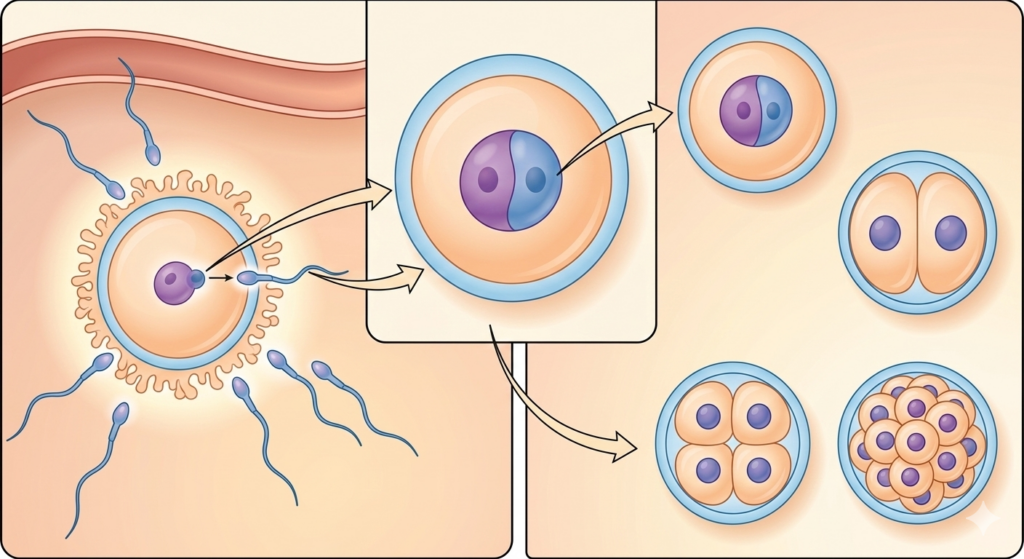
The zygote doesn’t just sit still. A few hours after it is formed, it begins to divide rapidly in a process called cleavage. It travels through the fallopian tube toward the uterus, transforming from a single cell into a complex cluster.
- Cell Division: The zygote divides into 2, 4, 8, and 16 cells, without initially increasing in overall size.
- Development: After about 3 to 4 days, it ceases to be a zygote and becomes a morula.
- Journey: All of this takes place while it searches for a safe place in the uterine wall to implant itself.
Expert Tip: The zygote is the only stage in which we consist of a single cell. After the first cell division, which occurs about 24 to 30 hours after fertilization, the technical term becomes “embryo.”
The importance of genetic makeup
The zygote determines the biological sex and all hereditary characteristics. If the sperm that fertilized the egg carried a Y chromosome, the baby will be male; if it carried an X chromosome, the baby will be female.
This cell is considered totipotent, which means it has the ability to generate not only the baby’s body but also extraembryonic tissues, such as the placenta and the umbilical cord. It is the miracle of biology concentrated in a microscopic space.
The biological process of fertilization and the origin of life
Life doesn’t ask for permission; it begins the very moment the sperm finishes the race and penetrates the egg’s zona pellucida. This encounter, which seems like a scene from a movie, is what we call fertilization. There, in that split second, the zygote is born: the first cell of a new human being. It is the starting point of existence, where the father’s and mother’s DNA merge to create a completely unique genetic code. It’s not just biology; it’s the official beginning of your story, carrying all the instructions to form eyes, a heart, and every little part of your body.
The process begins in the fallopian tubes. Millions of competitors try their luck, but only one manages to fuse with the egg. When this happens, the egg immediately “locks” itself to prevent any other intruders from entering.
At that moment, the father’s 23 chromosomes combine with the mother’s 23. The result is a diploid cell with 46 chromosomes. The zygote is living proof that genetic diversity is the foundation of our species, blending the genetic heritage of generations.
The fusion of genetic material
Inside the zygote, a process called anaphase takes place. The nuclei of the gametes dissolve, and the chromosomes organize themselves into pairs. It is precisely at this stage that the baby’s sex and all physical characteristics are irreversibly determined.
The first journey toward the womb
The zygote doesn’t just sit around resting. About 30 hours after fertilization, it begins cleavage, a series of rapid cell divisions. As it multiplies, it travels slowly through the fallopian tube toward the uterus to find a safe place to grow.
- Fertilization: The triumphant union of the sperm and the egg.
- Nuclear Fusion: The blending of DNA that creates a new identity.
- Zygote: The formation of a single cell, powerful and full of life.
- Cell division: The process by which a cell begins to divide, eventually forming an embryo.
Expert Tip: The zygote is a totipotent cell. This means it has the incredible ability to develop into any type of tissue in the human body, from a neuron to a cell in the big toe.
The origins of human complexity
Although it appears to be nothing more than a "tiny ball" under a microscope, the zygote already contains all of its biological programming. It regulates energy consumption and the chemical reactions necessary to survive the first few days of independent life, even before implantation.
Each subsequent cell division increases the complexity of this new being. What was once a single cell soon becomes a morula and then a blastocyst, proving that the miracle of life is governed by impeccable mathematical and biological precision.
Genetic characteristics: the combination of maternal and paternal DNA
The zygote is the starting point of your genetic history. At that exact moment, 23 chromosomes from the mother and 23 from the father merge to create a completely new and unique code. It’s as if nature took two immense libraries and chose the best pages to write an entirely new book. This union defines, in a fraction of a second, your entire biological potential, from eye color to health predispositions that will accompany you throughout your life.
The encounter between the sperm and the egg sets off a fascinating molecular dance. As soon as the membranes fuse, the genetic material organizes itself into pairs, ensuring that the new cell has the correct number of instructions to begin cell division.
The total of 46 chromosomes
Each parent contributes exactly half of life’s “blueprint.” The result of this combination is 23 pairs of chromosomes, totaling the 46 that make up the human body. This combination is what we call genetic variability—the mechanism that prevents us from being identical copies of our parents and ensures the evolution of the species.
- Mitochondrial DNA: An interesting fact is that this aspect of cellular energy comes exclusively from the maternal lineage.
- Homologous Chromosomes: These are pairs that contain genes for the same traits, one from each side of the family.
- Recombination: Pieces of DNA are exchanged, creating a unique genetic identity.
The definition of biological sex
The egg always carries an X chromosome, but the sperm holds the deciding vote. It can carry either an X or a Y. If the winning sperm carries an X, the zygote will be female (XX). If it carries a Y, the development will follow the male pathway (XY).
Expert Tip: Although a person’s genetic makeup is determined at the moment the zygote forms, the environment and the expectant mother’s lifestyle can influence how these genes “express themselves”—a phenomenon known as epigenetics.
Dominance and recessiveness
In this genetic battle, certain traits take center stage. Dominant genes need only one copy (from either the father or the mother) to express a trait. Recessive genes, on the other hand, only appear if both parents pass on the same genetic instruction, which explains why traits like light-colored eyes can “skip” generations in a family.
Stages of development: the transition from zygote to embryo
Life begins in an instant. The zygote is the starting point—the first cell formed when the sperm fertilizes the egg. But this stage is brief: it lasts only about five to seven days.
During this period, the zygote travels through the fallopian tubes while dividing rapidly. When it develops into a hollow ball of cells (the blastocyst) and implants itself in the uterus, the game changes. From the moment of implantation, it ceases to be merely a cellular entity and is now referred to as an embryo. It is the transition from potential to actual existence.
A step-by-step guide to the first week
Immediately after fertilization, the zygote wastes no time. It begins a process of cell division called cleavage. In less than 24 hours, that single cell becomes two, then four, eight, and so on, without increasing in overall size, but simply becoming more complex.
The morula stage
By about the third day, the cluster of cells resembles a blackberry, hence the name "morula." At this stage, the cells are "stuck together" and ready to begin differentiating, determining which cells will form the baby and which will become the placenta.
The blastocyst stage
Between the fifth and sixth day, the morula develops into a blastocyst. It is a structure with an internal cavity filled with fluid. This is the critical moment: the blastocyst must reach the uterus and find a cozy spot to implant itself.
- Day 1: Formation of the zygote in the fallopian tube.
- Days 2–4: Successive divisions and migration toward the uterus.
- Days 5–7: Development into a blastocyst and the start of implantation.
The big turning point: nesting
The official transition from zygote to embryo occurs upon implantation in the endometrium. When this cluster of cells “attaches” to the uterine wall, it establishes the connection needed to receive nutrients from the mother’s body.
Expert Tip: Many people confuse the date of ovulation with the start of the embryonic stage. Remember that the zygote is a lone traveler; the embryo is the one that has already “taken root” in the uterus.
Accelerated cell differentiation
Once implanted, the embryo begins to form the three germ layers. These layers are responsible for creating all the organs, bones, and tissues of the human body. It is an impressive feat of biological engineering that continues until the eighth week.
Hormones at work
Once the embryo reaches the uterus, the body begins to produce HCG (human chorionic gonadotropin). This hormone signals to the body that pregnancy has begun and prevents menstruation from occurring, thereby maintaining a safe environment for the embryo’s development.
Key differences between a zygote, a blastocyst, and a fetus
The journey of pregnancy begins with a single cell and ends with a baby ready to enter the world. Essentially, the zygote is the initial stage, formed the moment the egg and sperm unite.
The blastocyst, on the other hand, appears about five to seven days later; it is a more complex cluster of cells that attempts to implant itself in the uterus. Finally, the term “fetus” is only used starting in the ninth week of pregnancy, when the basic structure of the body and organs has already taken shape.
Zygote: The starting point
It all begins at conception. The zygote is the first stage of human life—a single cell that carries the complete DNA of both the father and the mother. It exists for only a short time, about 24 to 48 hours, as it begins its first divisions.
At this stage, it is still traveling through the fallopian tubes toward the uterus. It is the DNA that determines every detail, from eye color to hair type—all contained within a microscopic space.
Blastocyst: The Search for Shelter
After a few precise divisions, that single cell becomes a cluster called a blastocyst. It has an internal cavity filled with fluid and an outer layer that will develop into the placenta.
It is at this stage that implantation occurs—the crucial moment when the developing embryo “attaches” to the uterine wall. If this attachment is successful, the woman’s body begins to produce the hormone HCG in large quantities.
Fetus: The stage of development
Many people refer to everything as a fetus, but biology is precise. Before the fetus, we have the embryo (from the 2nd to the 8th week). The term “fetus” is only used starting in the 9th week of pregnancy.
At this stage, the basic "blueprint" is complete. The fetus already has fingers, eyelids, and functioning organs. The focus now shifts: the main goal becomes growing, gaining weight, and developing the lungs in preparation for the big day.
- Zygote: The single cell that forms immediately after fertilization.
- Blastocyst: A cluster of cells that implants in the uterus (5th to 7th day).
- Embryo: The stage during which the major organs and systems form.
- Fetus: Period of growth and development (from the 9th week until birth).
Expert Tip: Most very early pregnancy losses occur during the blastocyst stage, often before a woman even knows she is pregnant. This is nature’s way of ensuring that only healthy embryos continue to develop.
Location and path: from the fallopian tube to the uterus
The zygote begins its life in the widest part of the fallopian tube, known as the ampulla. That is exactly where the egg and sperm meet, but this new cell does not stay there for long.
The journey to the uterus takes, on average, 3 to 5 days. During this journey, the zygote not only travels but also transforms, dividing into several cells as it moves through the fallopian tube in search of fertile ground.
The driving force behind the movement
To cover the distance, the zygote relies on essential mechanical assistance from the female body. The inner lining of the fallopian tube has microscopic cilia that beat rhythmically toward the uterus.
These structures function like a small conveyor belt. In addition, the gentle muscle contractions of the fallopian tubes ensure that the embryo reaches its destination at exactly the right time for implantation.
The stages of the trip
- Fertilization: It begins in the ampulla of the fallopian tube.
- Cell division: The zygote divides into 2, 4, 8, and 16 cells during its development.
- Morula: The stage at which it resembles a blackberry, still in the fallopian tube.
- Blastocyst: The final stage that reaches the uterus, ready to implant.
The triumphant arrival and nesting
When it finally reaches the uterine cavity, the zygote (now a blastocyst) floats around for a day or two. It looks for a soft, nutrient-rich spot in the endometrium to implant itself.
This process of implantation is called nidation. It is the moment when the pregnancy is truly established, marking the beginning of the exchange of nutrients and oxygen between the mother and the developing fetus.
Expert Tip: The health of the fallopian tubes is crucial for this process. Any scarring or inflammation in the tubes can delay implantation, which requires medical attention to prevent the embryo from implanting in the wrong place.
How the zygote determines sex and biological characteristics
At the moment of fertilization, the zygote already determines the biological future of the new being. This single cell carries the complete set of instructions, in which biological sex is determined by the sperm’s chromosome (X or Y).
While the egg always contributes an X chromosome, it is the male gamete that “calls the shots.” If it contributes an X, the result is XX (female); if it contributes a Y, the result is XY (male). It is a rapid, precise, and irreversible process that occurs even before the first cell division.
Genetic heritage in 46 pieces
The zygote functions like a highly compressed digital file. It combines 23 chromosomes from the mother and 23 from the father, totaling the 46 chromosomes that make up the complete human genome.
In this mix, genes combine to dictate the body’s rules:
- Dominant Traits: Characteristics that appear even when only one copy of the gene is present (such as brown eyes).
- Recessive Traits: These traits only appear if both parents pass on the same gene (such as blue eyes).
- Variability: Recombination ensures that every individual is biologically unique in the world.
What DNA determines right away
Don’t think that the zygote determines only physical appearance. It establishes the biological foundation for the functioning of the entire body, from blood type to metabolic rate.
Expert Tip: The zygote is the architectural blueprint of life. DNA is the technical drawing, and based on it, future cells will know exactly how to build every detail of the human body.
Individuality in the first cell
This initial genetic makeup determines our biological identity. Even though our environment shapes who we become, the "blueprint" is all there, stored in the nucleus of that microscopic cell.
Skin color, hair texture, and a predisposition to certain health conditions are determined at that moment. The zygote not only marks the beginning of life; it also shapes each human being in a unique and irreplaceable way.
Factors that ensure the viability and health of the first human cell
For life to truly take hold, the viability of the zygote depends on a perfect alignment between genetics and the environment. The success of this first human cell requires the integrity of all 46 chromosomes (23 from each parent) and an immediate supply of energy from the mother’s mitochondria. Without this solid foundation, the journey toward the uterus does not even begin.
Early cellular health is determined by the quality of the gametes. If the egg or sperm carries serious DNA defects, the zygote may cease developing prematurely. This is a natural selection mechanism that prioritizes biologically viable and healthy embryos.
The critical role of the tubal environment
The journey of the zygote through the fallopian tubes is not merely a physical movement. This journey provides the nutritional support and pH balance necessary for the first cleavages (cell divisions) to occur without error.
- Mitochondrial Support: All the energy required for the initial cell divisions comes exclusively from the egg.
- Hormonal Synchronization: A woman’s body needs to prepare the endometrium through progesterone while the zygote travels.
- Protection of the Zona Pellucida: This "shell" protects the zygote from infections and prevents it from implanting in the wrong place.
Nutrition and Cell Protection
Cell division consumes enormous amounts of energy. The zygote operates on its own energy supply until it manages to implant in the uterus and establish a connection with the maternal circulation. Any external interference, such as toxins or oxidative stress, can compromise this phase.
Expert Tip: The viability of the zygote is highly sensitive to the parents’ lifestyle in the months leading up to conception, since the health of the gametes determines the new cell’s initial “energy reserve.”
Maintaining metabolic balance is what ensures that a single cell can multiply into billions in just a few days. The zygote must be resilient and, at the same time, extremely responsive to chemical signals from the mother’s body to ensure its survival.
Frequently Asked Questions (FAQs)
What is the difference between a zygote, an embryo, and a fetus?
The zygote is the single, initial cell formed immediately after fertilization. After the first cell division, it is referred to as an embryo, a stage that lasts until the eighth week of pregnancy. Starting in the ninth week, when the body’s basic structures have already formed, it is classified as a fetus.
Where is the zygote formed in the human body?
The zygote usually forms in the fallopian tubes. This is where the sperm meets the egg and fertilization occurs. After it forms, the zygote begins its journey down toward the uterus to implant itself in the endometrium.
How long does the zygote stage last?
The zygote stage is extremely brief in humans, lasting about 24 to 30 hours. This period ends as soon as the original cell completes its first mitotic division, splitting into two cells, which marks the beginning of the embryonic stage.
Does the zygote already contain the complete DNA of the new individual?
Yes. When the nuclei of the sperm and egg fuse (karyogamy), the zygote acquires a diploid set of chromosomes (46 in humans). It contains all the genetic information necessary for the organism’s development, determining characteristics such as biological sex, eye color, and blood type.
Can twins form from a single zygote?
Yes, this is the case with identical (monozygotic) twins. After a single zygote forms, it divides into two independent cell clusters during the early stages of cell division. Since both originated from the same zygote, the resulting individuals will be genetically identical.
Conclusion
The zygote marks the starting point of life for any organism that reproduces sexually. It is much more than a single cell; it is the biological convergence point where two distinct genetic heritages unite to create a unique and irreplaceable identity. Understanding what the zygote is allows us to grasp how the complexity of a fully formed human being begins with a microscopic and precise event of cell fusion.
Throughout its fleeting existence, the zygote carries the complete biological blueprint of a new being, triggering complex cellular mechanisms that will initiate embryonic development. Its successful formation is the first and most critical step for the continuity of life, serving as the essential link between generations and the starting point for all the processes of specialization and growth that occur during pregnancy.